

Facilities
Calibration Facilities
Laboratory Calibration
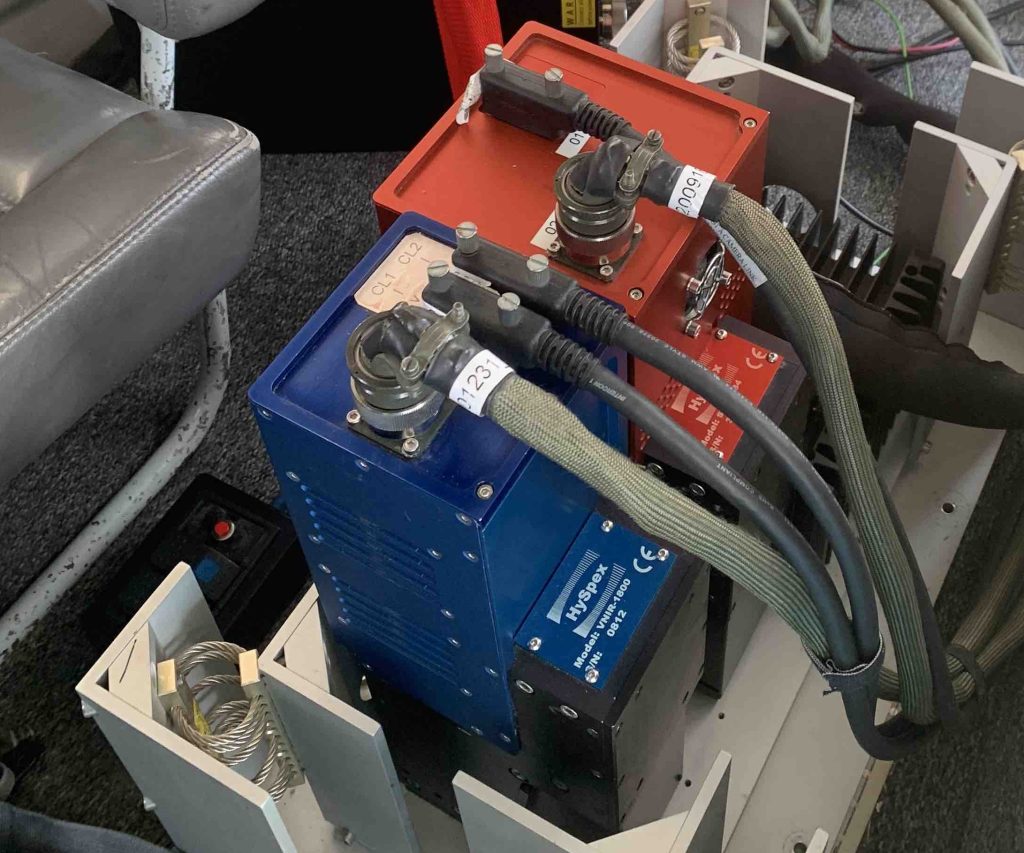
Laboratory calibration of the HySpex instrument includes determining radiometric calibration coefficients (to enable conversion of DN values to radiance and ultimately reflectance) as well as the dark signal, pixel responsivity / non-uniformity, band wavelength central positions, and the field of view (FOV) of each pixel. Further laboratory characterizations of the instrument provide additional information on the systems performance such as sensor linearity, SNR, dynamic range, stray light, spectral/spatial resolution and mis-registrations.
For field use the two HS cameras are mounted on an automated rotation stage affixed to a surveyors-grade tripod. In this configuration, acquisition of horizontal swaths of HS data are possible for targets at a distance of ~5 meters to hundred’s meters. A rugged, field portable data acquisition unit is used to control the rotation stage and cameras during in-situ imaging.
We relied on the instrument provider (NEO) of our Hyspex system for instrument calibration and to provide calibration coefficients using equipment traceable to NIST-equivalent European standards. We also have the NEON Sensor Test Facility, that can provide calibration traceable to NIST standards within the United States.
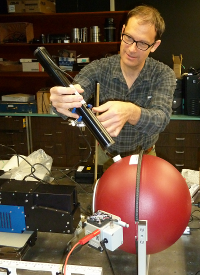
Now, HyLab works with UAFs optical sensor calibration lab (run by Co-PI Don Hampton) to monitor the stability of the manufacturer and NEON supplied calibration parameters using a complete calibrated Spherical Integrating Source (SIS) set (see photo on the left). Besides the bench-top, 300 mm diameter, barium-sulfate coated SIS with a 127 mm diameter port window, the set includes a 100W quartz halogen light source, a 4-channel optometer, and pencil style calibration lamps for various gas emission lines.
For field vicarious calibrations, concurrent with each airborne data acquisition missions, we set up a temporary meteorological station that records atmospheric temperature, humidity, wind speed and direction, and incoming and outgoing solar radiations. For teh first test flight near Fairbanks, we also use field-portable Microtops II Sunphotometer with a nearby Cimel sun photometer located at the Bonanza Creek AERONET (AErosol RObotic NETwork) site to record aerosol optical thickness (AOT) and column water vapor. Additionally, we used a Fieldspec Pro for target reflectance measurement of well-characterized ground targets in the Fairbanks area.
Data Processing Facilities
Processing Workflow
The HySpex data processing workflow is adapted from the DLR workflow and adds BRDF correction, which is particularly important for high-latitude imagery. The workflow consists of four main stages:
1. Image Orthorectification
Convert raw DN values to at-sensor radiance using HySpex calibration data.
Integrate IMU/GPS data and orthorectify VNIR and SWIR imagery using PARGE and a DEM.
Apply boresight calibration.
Outputs: Orthorectified VNIR/SWIR images, scan-angle files, and DEMs.
2. Supercube and DEM Derivatives
Combine VNIR and SWIR imagery into a single supercube using their common coverage.
Generate slope, aspect, and skyview products from the DEMs for subsequent corrections.
3. Radiometric, Atmospheric, and BRDF Corrections
Use ATCOR to convert at-sensor radiance to surface reflectance.
Correct for atmospheric effects using DEM information and atmospheric parameters such as water vapor, oxygen, and aerosol optical thickness.
Apply BRDF corrections using DEM-derived information.
Output: A data cube corrected for geometric, atmospheric, and BRDF effects.
4. Spectral Polishing, Mosaicking, and Binning
Remove remaining spectral artifacts when necessary.
Mosaic individual flight lines into a continuous dataset.
Apply spectral binning when needed to improve signal-to-noise ratio.
The final dataset is ready for end users and higher-order product generation.
Kandik: HyLab’s Processing Machine
HyLab is equipped with a new high-performance computing system, which is used for processing and managing the hyperspectral data acquired. Kandik is equipped with two NVIDIA L40S GPUs and can be expanded to accommodate up to ten GPUs.
All hyperspectral data processing tasks – such as spectral unmixing, supervised and unsupervised classification, and change detection – are performed using state-of-the-art machine learning and deep learning algorithms on this new platform.