

Instrumentation
Airborne Instrumentation
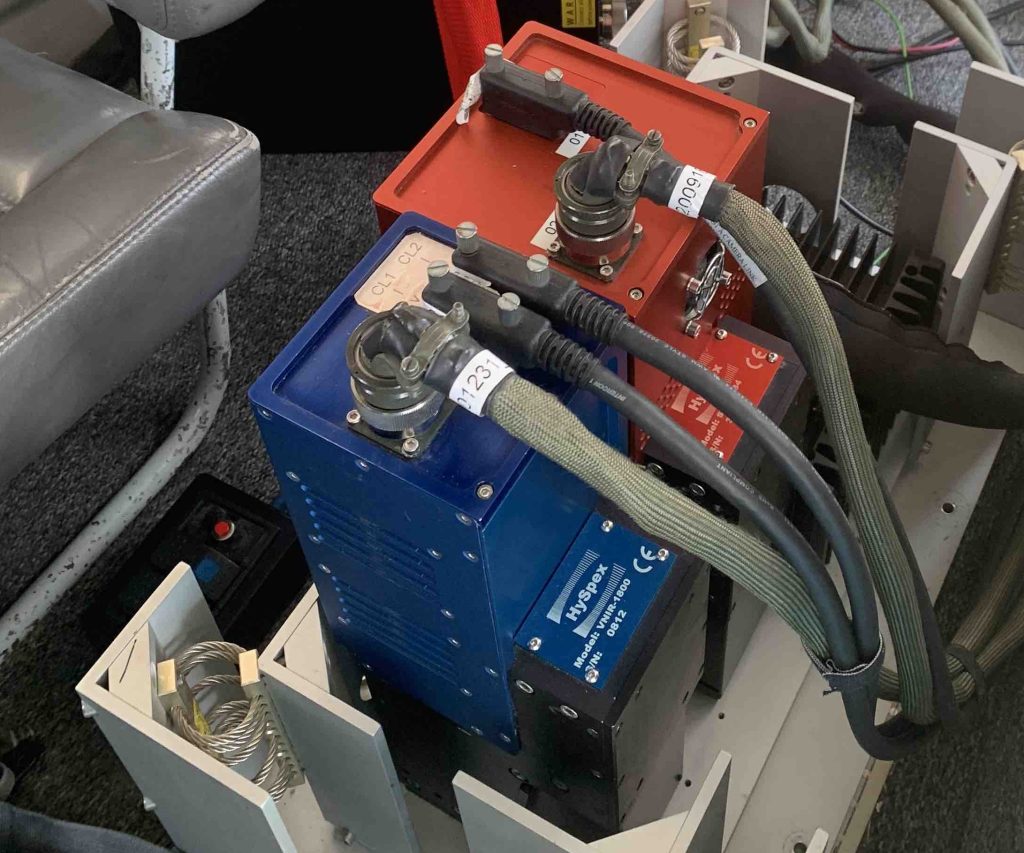
The instrumentation includes the HySpex VNIR-1800 and SWIR-384 cameras. Both units are pushbroom HS cameras that have low stray light levels, low sensitivity to polarization, and low smile and keystone effects (<10% of a pixel). The cameras have automatic electromechanical shutters for acquisition of dark offset. The VNIR-1800 unit is built on a Si CCD with 12 bit digitization and acquires data at a max frame rate of 160 fps. The SWIR-320m-e unit is built on an HgCdTe detector with 14 bit digitization. The SWIR FPA is equipped with 5 stage peltier cooling (monitored and PID regulated) to provide stable 195k temperatures and the camera can acquire data up to a maximum frame rate of 100 fps. The VNIR-1800 and SWIR-320m-e cameras have across track FOV of 17° and 13.5° respectively that can be increased to 34° and 27° respectively using a FOV expander that provides flexibility in terms of the ground swath width and pixel spatial resolution during airborne acquisitions.
Airborne Deployment
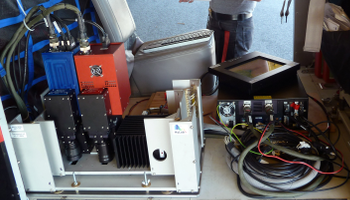
For airborne deployments the HySpex cameras are integrated with an IMAR iTrace RT-F400 IMU/GPS (Inertial Measurement Unit / Global Positioning System) unit in a mount with passive vibration dampening (see adjacent photo). The mount is compact and flexible to enable installation of the system in a range of aircrafts. The IMAR iTrace RT-F400 is a GLONASS-enabled GPS/IMU unit that records positional and angular information to an accuracy of 2 cm and 0.01 ° respectively with an update rate of 400 Hz.
An IMU/GPS unit with high accuracy and update rate is essential for accurate direct georeferencing of raw HS datasets particularly those acquired from smaller planes. During airborne surveys the HS cameras and IMU/GPS are controlled using a compact, high-performance data acquisition unit (running proprietary HySpex airborne operations software), connected with a 1 terabyte solid state drive and a compact, touch screen flat-panel monitor. This set up provides up to five hours of continuous data acquisition at the fastest possible data rates during airborne surveys.
Field Instrumentation
The Hyspex instrument is also configured for in-situ/field scanning. This capability bridges the scales between direct field spectroscopic measurements (eg. using a PSR+ or an ASD field spectrometer) and airborne hyperspectral data. In-situ imaging capabilities also support research training, and are important for teaching and outreach activities.
For field use the two HS cameras are mounted on an automated rotation stage affixed to a surveyors-grade tripod. In this configuration, acquisition of horizontal swaths of HS data are possible for targets at a distance of ~5 meters to hundred’s meters. A rugged, field portable data acquisition unit is used to control the rotation stage and cameras during in-situ imaging.