


Hyperspectral Imaging
About Hyperspectral Imaging
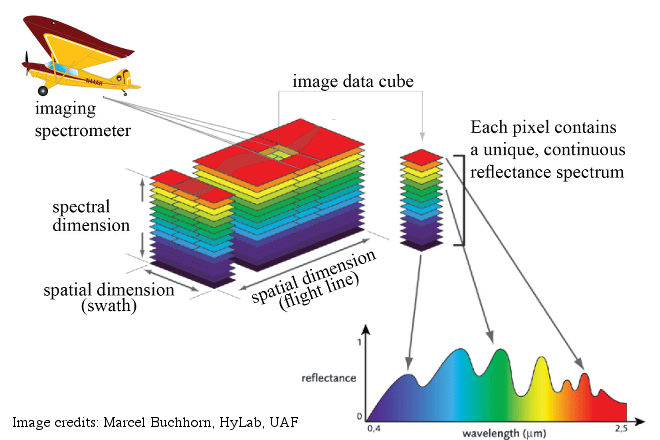
Hyperspectral imaging, also known as imaging spectroscopy, is an advanced remote sensing technology that helps researchers to measure rather than simply observe from a distance. The technology uses sophisticated sensors that can scan and generate hundreds of images of any target material on the surface of the Earth. These images can be used together to reconstruct the unique pattern in which the material reflects energy, thereby accurately identifying the target. As an example, hyperspectral imaging makes it possible to detect and identify individual minerals in an exposed surface, differentiate between healthy and infected trees of the same specie, and map contaminant distribution in land, water, and air.
Hyperspectral Tasks
Hyperspectral imaging supports a wide range of analytical tasks by exploiting the detailed information captured across hundreds of contiguous wavelength bands. Classification assigns each pixel in a scene to a specific land-cover or material class—such as vegetation, minerals, or urban surfaces—based on distinctive spectral signatures. Spectral unmixing addresses the common occurrence of mixed pixels by decomposing each spectrum into a set of pure component spectra (endmembers) and their corresponding fractional abundances.
Target detection focuses on identifying specific materials of interest, even when they occupy only a small portion of a pixel or are embedded within complex backgrounds. Change detection compares images acquired at different times to reveal meaningful spectral differences associated with physical or chemical changes, such as vegetation stress or land-use transitions. In contrast, anomaly detection requires no prior knowledge of the target; it highlights pixels whose spectral behavior deviates significantly from the background, making it particularly useful for discovering unknown or unexpected materials.
Together, these tasks form the core analytical framework of hyperspectral remote sensing, each addressing a distinct yet complementary aspect of extracting actionable information from high-dimensional spectral data.